Digigear Industrial Grade Low Profil Front Load PCIe/PCI Express to ExpressCard Adapter/Reader/Writer:
PCE10
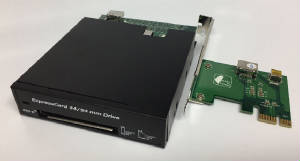
Features:
Supports 34mm & 54mm ExpressCard
Works
with ExpressCard devices including Wireless Wide Area Network modems (such as CDMA, EV-DO, GPRS, etc.), SATA controllers,
FireWire (400 & 800) adapters, flash card adapters, TV tuners, security, legacy I/O (PS2, serial, parallel), optical disk
drives, GPS receivers, and more…
Push- Push mechanism for easy insertion
of Express Card
Install in the front of PC 3.5” slot
Supports max 5 Gb/s
express new card.
Supports 480Mb/s USB 2.0 express card.
Enable Hot-
Swap
A type USB Host for other USB device like mouse or keyboard…etc
5 G bps PCI
Express Cable
OS:
Microsoft Windows Vista™ and future versions
Microsoft
Windows Server™ 2003/2000/ XP
Standard Type:
1 socket for PCI-E/USB 2.0 ExpressCard.
1 USB host for other USB devices.
Package Contents:
3.5” ExpressCard Bay x1
PCI-E Adapter x1
PCI-E(HDMI) Cable x1
Internal USB Cable x1
Manual x1
Things to Know
when Using the Reader:
There are two interfaces of ExpressCard: PCI-E ExpressCard and USB 2.0 ExpressCard. Standard Type
and Advanced Type card reader accept both PCI-E and USB 2.0 ExpressCard, but the Basic Type card reader only accepts USB 2.0
ExpressCard.
When using the USB 2.0 ExpressCard, the system will automatically identify the ExpressCard and add new device
at the insertion of the card.
When using the PCI-E ExpressCard, the system cannot automatically identify new device,
so the user need to add new device manually.
After inserting the PCI-E ExpressCard, please do following procedure and
enter:
Control Panel - System - Hardware - Device Manager -Scan for Hardware Changes.
After the scan, the system
will identify the ExpressCard and add new device.
The card reader does not require any driver to be installed. It is
when a device is plug into the reader that the system would detect that device and ask for a driver for the ExpressCard.
Although the reader supports Hot-Swap function, we still suggest the
ExpressCard should be inserted before power on
the system.